Book discussion blog for the Evanston Public Library featuring books by or about African Americans, book reviews, author biographies, reader's advisory, and book discussion guides.
This month we're reading Negroland, Margo Jefferson's memoir of growing up light skinned, middle class and privileged in 1950s Chicago. She explains how despite the benefits of a comfortable lifestyle, she and members of her generation were under constant pressure to "uplift the race" not "show their color" or contaminate themselves by associating with lower class, often darker skinned African Americans.
In an interview with NPR's Fresh Air, Jefferson reveals that, ultimately, it was the Black Power movement that led her to
question some of the tenets that she had grown up with: "Black Power was
really a major challenge to the social privileges and structures of the
kind of privilege that I had grown up with," she says. "That whole
belief ... that you will only be able to advance if you are perfectly
behaved, if you present yourself as what white people would consider an
ideal of whiteness ... all of that just began to burst open."
Is the concept of "Negroland" a relic of the past, or do upper class African Americans still experience the pressures Jefferson faced? And how strong is the class/color dividing line in 21st century Black America? We'll wrestle with these questions at our discussion on April 19th, 7:00 pm.
**Jefferson will be speaking as part of the Chicago Humanities Festival on April 30th . Her talk, accompanied by Darryl Pinckney, author of Black Deutschland, is on "Style and the Black Bourgeoisie". Not to be missed!
Disintegration : the splintering of Black America by Eugene Robinson Examines conflicts between 4 different subgroups within African American life: the "Abandoned" urban underclass; the "Mainstream" educated middle class; the super-rich, super elite "Transcendent"; and the "Emergent" population of mixed race and African/Caribbean immigrants.
Looks at the subtle forms of prejudice that black
professionals endure: a black woman may be hired in public
relations, but then whites will see the position as weak and
nonintellectual; a black male lawyer hired to
fill a quota may file brilliant briefs, but he'll be held back from a
partnership. Written in 1993, but still pertinent.
Well,
no one thinks Bill Cosby is right about anything these days, but this
remains a provocative look at the "Afristocracy" and their disdain for
low income urban Black Americans.
Greeting! Can't believe it's been nearly 3 months since I last posted! Thanks to everyone who attended the combined KeepintiReal/AAL discussion ofMy Grandfather Would Have Shot Me, the gripping memoir by Jennifer Teege, an African/German woman who accidentally discovered that her father was the Nazi commandant from Schindler's List.
For March, we are back to fiction with Boy Snow Bird, Helen Oyeyemi 's "gloriously unsettling" re-working of the Snow White. In a small town in the mid-50s, the birth of a dark skinned baby girl unravels a marriage, a family and a town; and a young mother finds herself becoming the "evil stepmother" she never imagined she could be. Join us for the discussion next Tuesday March 15th at 7:00pm! We have copies available at the 2nd floor desk: call 847-448-8620 to reserve yours.
Some new books of interest...
Blood Brothers: The Fatal Friendship Between Malcolm X and Muhammad Ali, by Randy Roberts and Johnny Smith
Sports historians Roberts and Smith delve deeply into the little-known intricacies and
tragic consequences of the close bond between the mentoring Nation of
Islam minister Malcolm X and the young boxer Cassius Clay. As the
authors tell the gripping personal stories of these two passionate
revolutionaries and seekers, they cover Clay's genius for audacious self-promotion and
strategic self-concealment, and Malcolm X's dream of resolving his
increasingly dire conflict with the Nation of Islam leader Elijah
Muhammad by bringing Clay and his burgeoning international fame fully
into the fold. Vividly set within the coalescing civil rights movement,
this incisive anatomy of a fatal friendship turns on the bitter irony
that Clay, soon to become Muhammad Ali, and Malcolm X became brothers in
spirit by virtue of their shared insistence on equality and freedom in a
racist society, only to be drawn to the Nation of Islam, which betrayed
and terrorized them both, forcing them apart and ultimately murdering
Malcolm X. Roberts and Smith portray both of these courageous and
controversial, inspired and inspiring men with fresh, stinging clarity,
and extend our perception of the interconnectivity of race, religion,
sports, and media during this violent and transformative era, which is
so very germane today.
The Defender: How The Legendary Black Newspaper Changed America, by Ethan Michaeli. The 2nd Baptist Men's group will be reading this in June, but now is your chance to get a head start! As you may remember from reading The Warmth of Other Suns, The Chicago Daily Defender played a key role in spreading hope to African American residents of the Deep South during the Great Migration; letting them know about job opportunities, and keeping them in touch with friends and relatives how had moved north.For decades, it has chronicled Chicago, and indeed national black society offering an alternative perspective on the issues of the day. Micaheli's book is the first comprehensive history of this iconic newspaper.
Brown is the New White: How the Demographic Revolution has Created a New American Majority , by Steve Phillips A manifesto to those seeking to
change the way politics plays out in America today. 51 percent of eligible voters in America today are
progressive people of color and progressive whites. Phillips has a
background in both politics and law, and here he lays out reasons why
white politicians (mainly calling out the whole of the Democratic party)
have stalled in producing effective social change stemming from the
progressive movement's failure to utilize this new and diverse eligible
voting majority. The book pulls no punches (there's a chapter titled, "Fewer Smart-Ass White Boys") but is ultimately hopeful. This slim yet
jam-packed call to action will be in demand, both because Phillips is a
popular pundit and because the time is ripe for an upheaval in
politics-as-usual.
It has been only a few months since Ta-Nehisi
Coates struck the American nerve, in Between the World and Me, by
pointing out that our racial history is more deeply ingrained in racism
than Gunnar Myrdal suggested. Here Princeton scholar Glaude adds to that debate
by equating our racist history to a basic gap in values, the notion
that black lives matter less in this country and always have. He proves
his point cogently, perhaps with less passion than Coates but with more
than enough documentation to move the argument along this new and
painful track. This is every bit as important a book as Coates' more
personal account.
Considering that any effort to achieve racial equality was viewed as
subversive in the Cold War era, is it any wonder that so many black
artists and writers were viewed as Communists? Yet very little has been
written about the black artists and writers who were surveilled,
investigated, and blacklisted because of their beliefs and their work.
Literary scholar Washington remedies that neglect with this engrossing
look at six artists: novelist and
essayist Lloyd L. Brown, visual artist Charles White, playwright and
novelist Alice Childress, poet and novelist Gwendolyn Brooks, novelist
Frank London Brown, and novelist and activist Julian Mayfield.. Though some were Communist Party members and others
not, they were all drawn to the Left's appreciation of black folk
culture and support for the ideal of self-determination, themes that
figured prominently in their work.
Hope those who celebrate had a Merry Christmas and a Happy Kwanzaa! And I hope everyone is looking forward to a fabulous New Year's Eve and 2016.
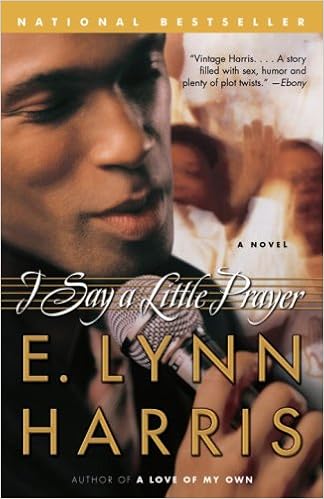
On Tuesday January 19th, please join me for our discussion of E. Lynn Harris' controversial I Say a Little Prayer. Harris, who died unexpectedly in 2009 at age 54, was a publishing phenomenon: by the time of his death he had had 10 consecutive books on the New York Times best-seller list, and had sold 4 million copies of his novels.
Harris's work was notable for its upwardly mobile African American characters, many of whom were gay or bisexual. I Say a Little Prayer looks at an issue of continuing relevance: the role of gay men and women in the black church. Chauncey Greer is a believer, a faithful member of his local church, and a mostly out gay man. Although he is accepted by his pastor, when Bishop Upchurch, a conservative televangelist shows up, Chauncey and the other gay congregants decide to take a stand against Upchurch's anti-gay preaching and politics.
Here's what surprised me about this book; although there is definitely some homophobia, and a lot of hypocrisy about sexuality in general, there is a lot more acceptance of gayness than I would have expected. Chauncey's co-workers, sister and pastor all know that he's gay, and don't have a problem with it. His parents aren't thrilled, but they continue to support and love their son. When the church music director organizes a "Day of Absence" for churchgoing gays and gay supporters, over a thousand people participate.
It's this complex portrait of the contemporary black community that made Harris so popular. Rather than the competing stereotypes of African Americans as either sex crazed thugs or mindlessly emotional holy rollers, Harris' characters embody both spirituality and sensuality. There are plenty of sexy characters in Harris' books, and most of them are sincerely devout churchgoers.I think Harris' world reflects the nuanced reality of African American life in the 21st century far more accurately than many supposedly "mainstream" writers.
Agree? Disagree? Let's talk about it on January 19th! We've still got a couple of copies here at the 2nd floor desk, and it's a quick read. Hope to see you soon!
Great discussion of The Turner HouseTuesday night! Sadly, Angela Flournoy did not win the National Book Award for fiction Wednesday, although Ta Nehisi Coates did win for nonfiction! Some news... Our next meeting won't be until January 19th, when we'll be discussing E. Lynn Harris'I Say a Little Prayer. Copies have already begun arriving, (sadly, they did not get here in time for our discussion Tuesday.) We have copies on hold for AAL at the 2nd floor desk; call us at 847-448-8620 or just stop by. I often run across books which would make great discussions, but there just aren't enough copies in the library system to do it. Here are a few recent titles I highly recommend... Where everybody looks like me : at the crossroads of America's Black colleges and culture Historically black colleges and universities, or HBCUs, have long been
the bedrock of black culture, graduating heroes like Toni Morrison, Thurgood Marshall, Oprah Winfrey, and Martin Luther
King Jr. But the 104 HBCUs are under siege: funding cuts have
forced universities to send home thousands of students, dozens of
college presidents have been ousted from their jobs, criminal
investigations have been launched, conservative legislators have schemed
to shut down schools, and overworked faculty have feuded with
bureaucrats. Chronicling this near breaking point for black colleges, Where everybody looks like me presents a compelling, tightly woven story
of the challenges faced by HBCUs.
In this comprehensive
history of the Illinois Chapter of the Black Panther Party (ILBPP),
Chicago native Jakobi Williams demonstrates that the city's Black Power
movement was both a response to and an extension of the city's civil
rights movement. Williams focuses on the life and violent death of charismatic leader Fred
Hampton, who served as president of the NAACP Youth
Council and continued to pursue a civil rights agenda when he became
chairman of the revolutionary Chicago-based Black Panther Party. Framing
the story of Hampton and the ILBPP as a social and political history
and using, for the first time, sealed secret police files in Chicago and
interviews conducted with often reticent former members of the ILBPP,
Williams explores how Hampton helped develop racial coalitions between
the ILBPP and other local activists and organizations.Williams also
recounts the history of the original Rainbow Coalition, an alliance of working class blacks, Latinos, and white Southerners, to show how the
Panthers worked to create an anti-racist, anti-class coalition to fight
urban renewal, political corruption, and police brutality.
In this timely new book, Tim Wise explores how Barack Obama's emergence
as a political force is taking the race debate to new levels. According
to Wise, for many white people, Obama's rise signifies the end of racism
as a pervasive social force; they point to Obama not only as a
validation of the American ideology that anyone can make it if they work
hard, but also as an example of how institutional barriers against
people of color have all but vanished. But is this true? And does a
reinforced white belief in color-blind meritocracy potentially make it
harder to address ongoing institutional racism? After all, in housing,
employment, the justice system, and education, the evidence is clear:
white privilege and discrimination against people of color are still
operative and actively thwarting opportunities, despite the success of
individuals like Obama. Is black success making it harder for whites to
see the problem of racism, thereby further straining race relations, or
will it challenge anti-black stereotypes to such an extent that racism
will diminish and race relations improve?
Broadway musicals are one of America's most beloved art forms and play
to millions of people each year. But what do these shows, which are
often thought to be just frothy entertainment, really have to say about
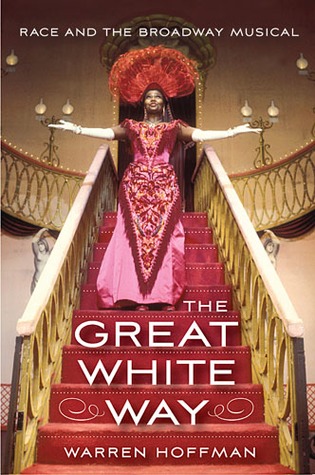
our country and who we are as a nation? The Great White Wayreveals the racial politics, content, and subtexts that have
haunted musicals from Show Boat (1927) to
The Scottsboro Boys (2011). Presented chronologically, The Great White Way shows how
perceptions of race altered over time and how musicals dealt with those
changes. New
archival research on the creators who produced and wrote these shows,
including Leonard Bernstein, Jerome Robbins, Stephen Sondheim, and
Edward Kleban, will have theater fans rethinking
how they view this popular American entertainment.
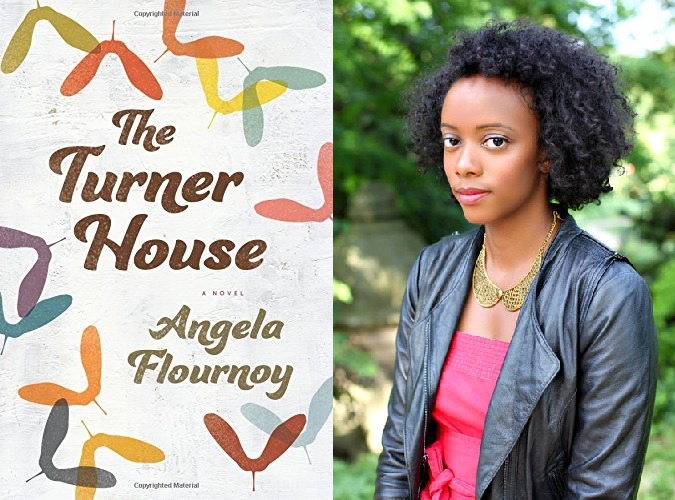
A family home is more than just a building; it can represent the hopes, fears, and memories that make a family a family. In The Turner House, Angela Flournoy skillfully traces the web of love affairs, betrayals, accidents, crimes and disappointments that have molded the Turner family, the 13 children of Francis and Viola Turner of Detroit. Francis has died, and a bedridden Viola does not realize that the family home has lost much of its value. Each sibling deals with this crisis differently, and each must come to terms with a problematic family legacy.
In this video for Well Read Black Girl , Flournoy reminds us that everyone needs to forgive their parents at some point to become a full fledged adult. Please join us this coming Tuesday November 17th, (the day before the National Book Award ceremony!) at 7 pm at Evanston Public Library as we discuss this beautifully layered novel. Call 847-448-8620 or stop by the 2nd floor desk to get a copy.
if you're a fan of The Warmth of Other Suns, I have very exciting news: author Isabel Wilkerson will be speaking at ETHS next Monday night November 16th, 7:00 pm! The event is free and no tickets are required. (Although I would suggest arriving early).
Hot discussion this past Tuesday on Medical Apartheid! One thing is clear: many African Americans of various ages and backgrounds feel deeply mistrustful of the American health care system. Stay tuned for more EPL health literacy programs in the near future.
We'll be moving back into fiction for our next two discussions. On November 17th, we'll discuss Valerie Flournoy's The Turner House, a novel treating some of the same issues we wrangled with in Family Properties; African Americans who discover that their property has not accumulated the wealth they thought it had. Yet this is also a rich story of African American family life in all its complexity, with brothers, sisters, cousins, aunts and uncles squabbling yet generally supportive of each others' needs and eccentricities. The Turner House is a National Book Award finalist.
We're skipping December (too much holiday shopping!) and will pick up again January 19th with I Say A Little Prayer, E. Lynn Harris's marvelous novel about a gay man confronting homophobia in the black church. I've been wanting to discuss a Harris book for ages, and this is one of his best.
Finally, February 16th we'll be teaming up with the KeepinitReal nonfiction group to read My Grandfather Would Have Shot Me, the memoir of a German-African woman who discovered that her grandfather was the notorious Nazi commandant featured in Schindler's List. How do you deal with the knowledge of such ultimate evil in your family tree, especially when that evil was directed at people who look like you?
In other news: be sure to catch the Chicago International Film Festival's Black Perspectives series, starting this weekend! Saturday night 10/25, pioneering black director Charles Burnett will be on hand to present his classic To Sleep With Anger, starring Danny Glover.
If you missed Gem of the Ocean at Court Theater, you have another chance to see an August Wilson play next month. Joe Turner's Come and Gone is on stage at Depaul Theatre School November 6th-15th, with previews on the 4th and 5th. Tickets are only $5-$15!
Aaannnddd, Raven Theatre is doing a highly acclaimed musical, Direct From Death Row; The Scottsboro Boys, in which the 9 young black men accused of rape in the 1930s, "return from eternity to our stage, where they keep their story alive
through songs, a magic act, skits and soft shoe - all to convey the
tawdry show that their case became".
 Is the concept of "Negroland" a relic of the past, or do upper class African Americans still experience the pressures Jefferson faced? And how strong is the class/color dividing line in 21st century Black America? We'll wrestle with these questions at our discussion on April 19th, 7:00 pm.
 Black bourgeoisie by Franklin Frazier
 Examines conflicts between 4 different subgroups within African American life: the "Abandoned" urban underclass; the "Mainstream" educated middle class; the super-rich, super elite "Transcendent"; and the "Emergent" population of mixed race and African/Caribbean immigrants.
 Well,
no one thinks Bill Cosby is right about anything these days, but this
remains a provocative look at the "Afristocracy" and their disdain for
low income urban Black Americans.
Well,
no one thinks Bill Cosby is right about anything these days, but this
remains a provocative look at the "Afristocracy" and their disdain for
low income urban Black Americans.